
Uncategorized
How Porsche Racing Livery Diecast Earns a Spot
Jul
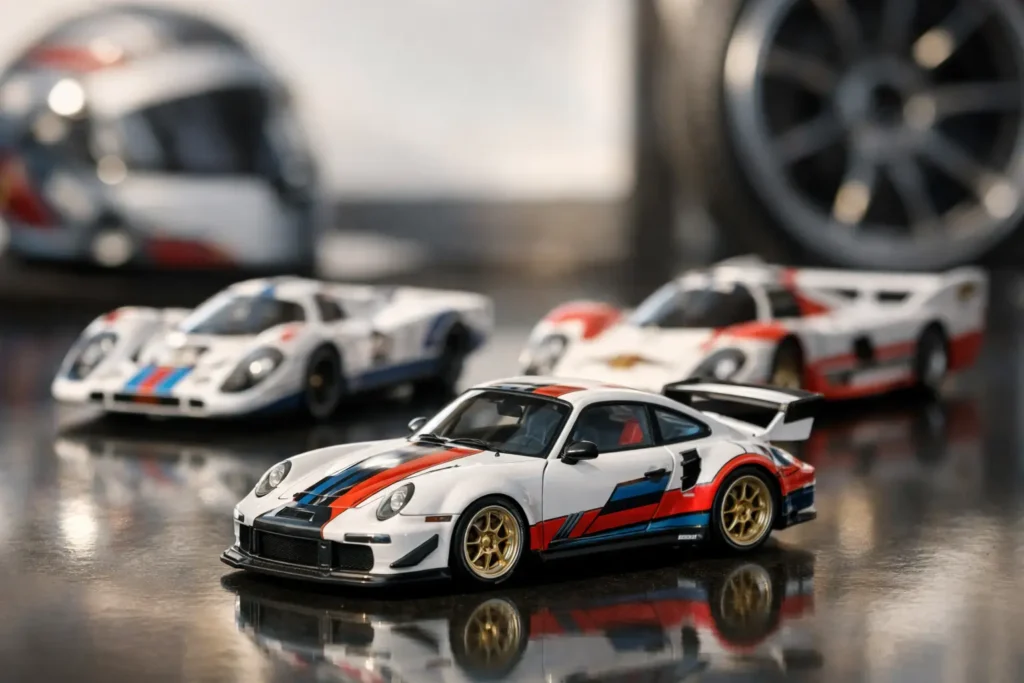
A Porsche racing livery diecast can make an ordinary display shelf feel like pit lane history. The shape may be familiar – a 356, 917, 935, 956, 962, 911 RSR, or modern 911 GT3 R – but the graphics are what give a model its story. A stripe pattern, a sponsor panel, a race number, or a set of period-correct wheels can identify a famous team, a landmark event, or an entire era of sports car racing.
For collectors, that makes a race-liveried Porsche more than a colorful version of a road car. It is a specific machine from a specific moment. Choosing the right one means looking past the paint and paying attention to the car, event, scale, manufacturer, and level of detail that fit your collection.
Why Porsche Racing Liveries Matter
Porsche has raced for decades in endurance racing, GT competition, rallying, and one-make series. That long history gives collectors an unusually wide field of liveries to chase. Some are factory works cars wearing instantly recognizable colors. Others represent privateer teams, customer racers, and regional entries that are harder to find but no less interesting.
The famous Porsche 917 is a perfect example of how a livery changes collector appeal. Its low, sweeping body is dramatic in any finish, but a period racing scheme turns it into a recognizable piece of Le Mans history. The same is true of a Porsche 956 or 962. Their bodywork is unmistakable, yet the number, sponsor placement, and team markings determine which race car is sitting in your display case.
Modern Porsche race cars work the same way. A 911 RSR or 911 GT3 R may share a basic casting with another release, while different race numbers and team graphics mark completely different entries. This is why experienced collectors read the full product name instead of shopping by model alone. Model year, team, race event, driver association, scale, and manufacturer all matter.
Choosing a Porsche Racing Livery Diecast by Era
A focused collection is often more satisfying than buying every Porsche race model that catches your eye. The right direction depends on the era that means the most to you and the space you have available.
Early endurance racers and the 917 era
Collectors who enjoy 1960s and early 1970s motorsport often look for 356, 550, 718, and 908 race cars before moving toward the 917. These models have a raw, purposeful look: simple roundels, exposed-looking mechanical details, narrow tires, and period sponsor graphics. They display especially well together because the visual evolution is easy to see, from lightweight sports racers to the wide, powerful 917.
The trade-off is that accurate period models can be more specialized. A collector may need to decide whether a particular release represents the exact race entry they want or simply captures the era. For some, a famous overall-winning car is the priority. For others, a less obvious car with an unusual color scheme is the better shelf piece.
Turbo legends, Group 5, and Group C
The Porsche 935, 956, and 962 are favorites for collectors who want aggressive aero, wide fenders, and bold sponsor treatment. This is the period where race liveries often become the focal point of the model. Bright stripes, contrasting wheels, large rear wings, and oversized numbers give these Porsches a serious presence in either 1/18 or 1/24 scale.
This era also rewards careful comparison. Two 962 models may look similar from a distance, but one can represent a different chassis configuration, team, or event. If accuracy is the goal, verify the race number, driver lineup, and event before calling a model a match for your collection theme. If you collect for visual impact first, choose the version with graphics that you will enjoy seeing every day.
Modern GT and endurance competition
Modern Porsche GT racers appeal to collectors who follow current IMSA, FIA WEC, Le Mans, Nürburgring, and customer-racing action. Their liveries can range from clean factory schemes to highly detailed partner graphics. The latest 911 race cars also give a display a useful contrast against vintage Porsches, showing how the classic rear-engine silhouette has continued into modern competition.
A modern race model can be especially appealing when it connects to a driver you follow or an event you watched. That personal connection matters. A carefully finished 911 GT3 R from a favorite endurance race can mean more than a historically bigger model with no direct link to your own motorsport memories.
Scale Changes the Experience
Scale is not just a measurement. It determines what you can see, where you can display the model, and how deeply a manufacturer can reproduce the original race car.
A 1/18 Porsche race car is often the choice for collectors who want a centerpiece. At this size, features such as roll cages, racing seats, harness details, brake hardware, wheel design, and fine sponsor printing can be easier to appreciate. Larger models also give the livery room to work. Small decals and striping stay readable, which is important on cars with busy endurance-racing graphics.
A 1/24 model offers a more compact way to build a broad Porsche lineup. It can be a smart choice if you want multiple generations of 911 racers, a complete endurance grid, or a mix of Porsche models without dedicating an entire wall to display cases. The level of detail may be simpler than a premium 1/18 release, but a well-executed 1/24 racer can still deliver strong proportions and a great-looking paint scheme.
Smaller scales can be ideal for livery-focused collecting, particularly when a manufacturer releases several versions of the same casting. You can build a visual history of a race platform without committing to larger, more expensive models. The compromise is that tiny decals and cockpit details naturally become less visible, so quality printing and clean paint application matter even more.
What to Check Before You Buy
A good Porsche racing model should look convincing from every angle, but collector details separate a standout release from a basic shelf filler. First, look at the exact identity of the car. Is it a 911 RSR, 935, 956, 962, or 917? Is the listed model year correct for the version represented? Motorsport names can be deceptively close, especially when a race car evolved through several seasons.
Then study the livery information. The race number should be clear, and the colors should be placed cleanly around body contours, wheel arches, and rear wings. Sponsor logos need sharp printing rather than soft or misaligned marks. On a premium model, details such as team decals, windshield banners, light covers, mirror colors, and tire branding can make a major difference.
Construction details deserve attention, too. Diecast metal bodies offer satisfying weight and a substantial feel, while resin models can capture highly accurate shapes but are often sealed. Neither format is automatically better. If opening doors, hoods, or engine covers is part of the fun for you, check whether the model has opening features. If you value a clean, exact body shape above all else, a sealed model may still be the right choice.
Limited-production status can add interest, especially for collectors building a focused Porsche or endurance-racing display. Still, a limited edition is not automatically a better purchase. A model you genuinely connect with is usually a stronger long-term addition than a rare release chosen only because the production number is low.
Building a Display That Tells a Racing Story
The strongest Porsche displays have a point of view. You might group cars by endurance era, collect only Le Mans entries, build a progression of 911 race cars, or place factory-backed models beside privateer versions. Even a small display becomes more engaging when the cars relate to one another.
Keep scale consistent within each group when possible. A row of 1/18 Porsche endurance racers has a clean museum-like look, while mixed scales work best when they are separated by shelf level or display zone. Arrange cars so the livery is visible from your normal viewing angle. Side graphics, race numbers, and rear wings often carry the most visual character, so avoid packing models too tightly.
Good lighting is worth the effort, but protect paint and decals from long periods of direct sunlight. Dust can dull windows and fine printed graphics over time, so enclosed cases are useful for premium models. Keep original boxes, certificates, and limited-edition packaging organized as well. They help preserve the full collector record of a release, even if the model spends its life on display.
Porsche race cars have always carried more than speed. They carry team identity, engineering eras, driver memories, and the visual language of the tracks where they earned their reputation. Whether you choose a legendary 917, a wide-body 935, or a current 911 GT racer, pick the livery that gives your collection a story you want to keep telling.
