
Uncategorized
How to Display Diecast Aircraft Safely at Home
Nov
A diecast aircraft collection can look like a clean flight line, a museum exhibit, or a crowded airport ramp. The difference usually comes down to placement. Knowing how to display diecast aircraft means protecting delicate landing gear, showing off liveries and markings, and giving each model enough room to feel like a collectible rather than shelf clutter.
Aircraft models ask for a different approach than diecast cars and trucks. Their wingspan takes up visual space quickly, antennas and pitot tubes can be fragile, and a polished fuselage will reveal every bit of dust. A smart display starts with the collection you have now, but leaves room for the Boeing, Airbus, military, or specialty aircraft models still on your want list.
Start With Scale, Wingspan, and Display Space
Before buying a cabinet or clearing a shelf, measure your largest model. Do not rely on scale alone. Two 1/200 aircraft can have very different wingspans, and a wide-body airliner will need considerably more room than a single-engine fighter at the same scale.
Place the model on a flat surface and measure from wingtip to wingtip, nose to tail, and from the tabletop to the highest point of the tail. Add at least 2 to 3 inches of open space around the wingtips for a clean look and safer handling. If you plan to display models at an angle, allow more depth than the aircraft itself appears to need.
A collection built around one scale is usually easiest to display. A row of 1/400 commercial aircraft creates a compact airport-style scene, while 1/200 pieces make stronger individual statements. Larger 1/72 military aircraft bring out cockpit, armament, and panel details, but they can quickly outgrow a standard bookcase. Mixing scales is not wrong, especially when the collection is organized by airline, era, or aircraft type. Just avoid placing a small 1/400 airliner directly beside a large 1/72 fighter unless the contrast is intentional.
Choose a Display That Supports the Model
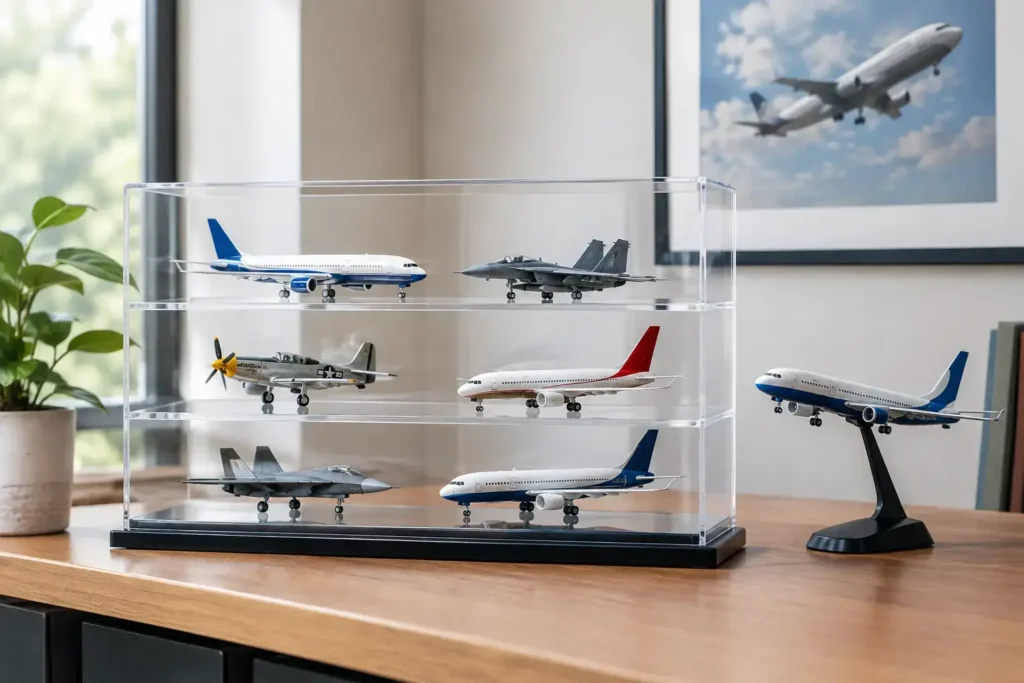
An enclosed glass or acrylic cabinet is often the best option for valuable diecast aircraft. It cuts down on dust, keeps casual hands away from delicate parts, and gives the collection a finished presentation. Look for adjustable shelves so you can give tall tails and display stands proper clearance.
Open wall shelves work well for larger models or a growing collection, provided they are mounted securely and kept away from busy walkways. Choose shelves deep enough that the nose gear and tail are not sitting near an edge. A bump against a shelf can turn a carefully painted model into a repair project.
A bookcase is a practical starting point, but check shelf depth before arranging aircraft nose-forward. Many standard bookcases are too shallow for wide-body models, which can leave wings extending beyond the front edge. In that case, display the aircraft diagonally or use a side-on layout.
For a single premium piece, a clear display case can make sense. It protects a limited-production model while keeping its livery visible from several angles. Cases are especially useful for aircraft with fine antennas, open panels, or detailed landing gear that should not be handled often.
How to Display Diecast Aircraft With Stands
Most collectors display airliners on their landing gear because it gives the model a realistic gate or ramp presence. If the gear is well made and the surface is level, this is a solid choice. Keep the model supported by its wheels, not by a soft surface that can shift or press unevenly against the tires.
Display stands create a more dynamic look. An aircraft shown in climb, cruise, or banking position uses less shelf width and lets viewers see its underside, engine detail, and wing profile. Stands also work well for military jets where the in-flight pose matches the character of the aircraft.
There is a trade-off. A stand can place stress on a mounting point if the aircraft is heavy or if the model is bumped. Use the stand supplied by the manufacturer whenever possible, and make sure the peg fits without forcing it. Never drill into, glue, or modify a collectible just to make it fit a generic stand. That can damage the finish and reduce collector appeal.
If you use several stands, vary the heights carefully. A staggered arrangement can create the feeling of an airshow formation, but keep wingtips, tails, and propellers well apart. A crowded sky display may look exciting from across the room, yet it is far less enjoyable when every cleaning session feels risky.
Build a Theme Instead of Filling Every Inch
The strongest displays give the eye a clear reason for each group of models. You might organize commercial aircraft by airline, aircraft family, route region, or livery era. A Boeing 747, 767, 777, and 787 sequence tells a story even before a collector reads the model names.
Military aircraft can be grouped by branch, mission, conflict, manufacturer, or time period. A shelf dedicated to Cold War jets will read differently from one built around modern stealth aircraft or World War II fighters. A smaller themed display often has more impact than a crowded assortment of unrelated models.
Use a few simple visual anchors. A printed airport runway backdrop, a restrained aviation photo, or small nameplates can add context without pulling attention from the castings. Avoid scenery that is oversized for the models. A 1/400 aircraft next to a large unscaled terminal or toy vehicle can make an otherwise sharp collection look mismatched.
Leave some open shelf space on purpose. That breathing room makes a special colorway, commemorative livery, or hard-to-find release feel more significant. It also leaves a natural landing spot for the next addition to your collection.
Use Lighting That Shows Detail Without Causing Damage
Good lighting brings out metallic paint, airline markings, cockpit windows, engine nacelles, and landing gear. Cool or neutral LED lighting is generally the collector-friendly choice because it produces little heat and can be aimed precisely. A small LED strip beneath the front of a cabinet shelf can illuminate a row of aircraft without creating harsh shadows.
Keep diecast aircraft out of direct sunlight. Sunlight can fade paint and decals over time, while the heat near a window can affect plastic parts, rubber tires, and display bases. This matters even in a room that does not feel especially warm. A few hours of strong afternoon sun can be enough to create uneven fading on one side of a collection.
Avoid placing lights so close that they create bright glare on windshields or glossy fuselages. Test the display at normal viewing height, not only while standing directly in front of it. Sometimes moving a light a few inches forward or upward makes the markings much easier to see.
Protect Your Aircraft From Dust, Heat, and Handling
Dust is the routine enemy of a diecast aircraft display. It settles on wings, inside engine intakes, and around detailed landing gear. A soft makeup brush or a clean, soft detailing brush is usually safer than wiping the model with a cloth, which can snag small parts. Use gentle strokes and support the aircraft body if you need to steady it.
For more stubborn dust, a hand-operated air blower can help, but keep the airflow light. Compressed air cans can be too forceful and may spray moisture or propellant if used incorrectly. Do not use household cleaners, alcohol, or abrasive cloths on painted surfaces, decals, and clear cockpit pieces unless the manufacturer specifically recommends them.
Keep the display away from heating vents, kitchens, bathrooms, and humid basements. Temperature swings, grease in the air, and moisture are not friendly to long-term storage. If the room has pets or young children, an enclosed cabinet is usually worth the extra cost.
When moving a model, hold it by the strongest part of the fuselage with a second hand supporting the underside. Do not lift it by wings, tailplanes, engines, landing gear, or propellers. If the model came with a protective cradle or box, save it. Original packaging is useful for storage, moving, and preserving a collectible release.
Rotate the Collection When Space Is Limited
Not every aircraft needs to be on display year-round. Rotating models lets you enjoy more of the collection without packing shelves too tightly. You might feature commercial airliners during one season, then switch to military aircraft, cargo planes, or aviation anniversary liveries later.
Store off-display pieces in their original boxes whenever possible, in a dry indoor area away from attic heat and garage temperature swings. Label the outside of each box with the aircraft type, airline or squadron, scale, and manufacturer. It saves time when you are looking for a particular release and makes future display changes much easier.
The best aircraft display is not necessarily the largest one. It is the one that lets you see the exact details that made you choose each model in the first place. Give your favorites room to fly, protect the pieces that took time to find, and let the next great addition earn its place on the shelf.
