
Uncategorized
How to Build a Corvette Diecast Model Collection
Jul
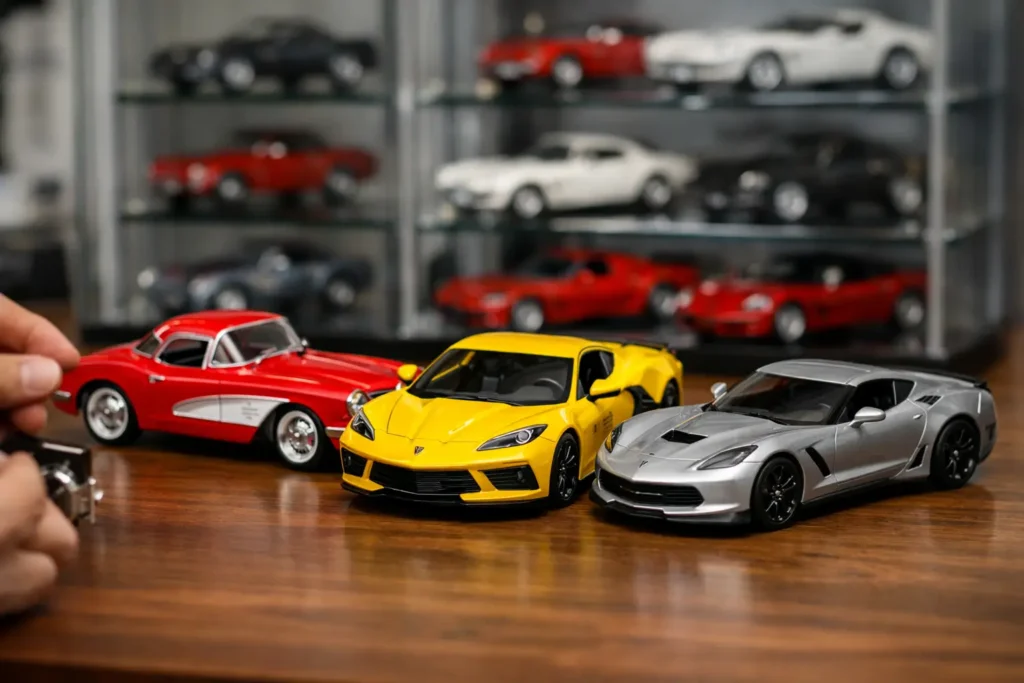
A Corvette collection gets interesting the moment you stop seeing it as a row of red sports cars. The split-window C2, shark-nose C3, 40th Anniversary C4, Le Mans-ready C5-R, and mid-engine C8 each tell a different chapter of American performance history. A Corvette diecast model collection gives you the chance to put those chapters together in the scale, color, and level of detail that fits your space and budget.
For some collectors, the goal is one standout 1/18 model with opening doors and a detailed engine bay. For others, it is a long-term hunt for every generation, pace car, racing livery, and factory color variation. Both approaches work. The best collection is not the largest one. It is the one with a clear point of view.
Pick a Corvette collecting lane first
Corvette has been in production since 1953, which makes it easy to buy models without a plan and end up with a display that feels random. A collecting lane gives your search some direction without taking the fun out of an unexpected find.
You might build by generation, starting with the chrome-heavy C1 and moving through the C2, C3, C4, C5, C6, C7, and C8. This is one of the most satisfying formats because the body lines change dramatically from era to era. A seven-generation lineup also makes a strong shelf display, especially when every model is in the same scale.
Another route is to collect a specific Corvette theme. Sting Rays and Stingrays make a natural group, as do Indianapolis 500 pace cars, ZR1 models, Grand Sports, and Corvette Racing cars. If motorsports is your focus, race numbers, sponsor graphics, driver associations, and event-specific liveries matter as much as the body style. A C5-R and C8.R can show decades of Corvette endurance-racing development in just two pieces.
Color can be the theme, too. Rally Red, Daytona Sunrise Orange, Le Mans Blue, Arctic White, Millennium Yellow, and Torch Red are not simply paint choices to many Corvette fans. They are part of the model’s identity. A color-focused collection works especially well for collectors who want variety while staying visually coordinated.
Choose the scale before buying multiples
Scale affects detail, price, storage, and how the finished collection looks. It is worth deciding early, particularly if you want to display several Corvette generations side by side.
The 1/18 scale is the classic choice for collectors who want a centerpiece model. At roughly 10 to 11 inches long for most Corvettes, these replicas can show interior trim, brake rotors, engine components, badges, and functional features such as opening hoods or doors. The trade-off is shelf space. A growing row of 1/18 cars needs a proper display case or dedicated cabinet.
The 1/24 scale offers a strong middle ground. It is large enough to appreciate body contours, wheels, interior detail, and special graphics, but compact enough to build a broad generational run without giving up an entire room. For gift buyers, 1/24 is often a safe choice because it feels substantial and display-ready.
Smaller 1/64-scale Corvette castings are ideal for collectors who enjoy chasing releases, series, wheel variations, and packaging. They also make it realistic to collect different colors, customs, track cars, and duplicate generations. Detail will naturally be less elaborate than on a premium 1/18 piece, but a carefully chosen 1/64 display can have more energy and range.
Mixing scales is fine when it is intentional. A large 1/18 C2 Sting Ray can serve as the focal point, with smaller Corvettes arranged below by generation or racing era. What tends to look less organized is mixing scales on the same shelf without separation. Use different tiers, cases, or shelves so each scale reads as its own display.
What to inspect on a Corvette diecast model
A familiar Corvette name does not guarantee that every release has the same collector appeal. Before adding a model, look closely at the details that distinguish an ordinary replica from the exact version you want.
Start with the year and trim. A 1963 Corvette coupe is not just another C2 when it has the one-year split rear window. A 1978 Indy pace car differs from a standard late-C3 coupe. A C6 ZR1, C7 Z06, and C8 Stingray may share the Corvette badge, but each represents a distinct performance specification and visual package.
Then look at the casting itself. Wheel design, ride height, front splitter shape, side vents, rear spoiler, and hood treatment can change the character of a model. On racing replicas, check the number, team, sponsor markings, class details, and driver names. These details matter most when you are building an accurate Corvette Racing or Le Mans display.
Packaging is another decision point. Carded models and boxed limited editions may be worth keeping sealed if your collection is centered on release condition, series completion, or resale flexibility. On the other hand, an unboxed model often displays better and lets you enjoy opening features and interior detail. There is no universal rule. Keep pieces sealed when the package is part of the collectible, and open pieces you bought to see and display.
Build depth instead of buying every red Corvette
Red Corvettes are popular for good reason, but repeating the same color and body style can make a collection feel flat. Add depth by choosing meaningful contrasts: a white 1953 roadster next to a blue 1967 coupe, a yellow C6.R beside a silver C7 ZR1, or a modern C8 in a bright factory color next to a blacked-out track-focused version.
Special editions can provide those contrasts naturally. Anniversary models, commemorative releases, pace cars, ZR1 and Z06 variants, convertible and coupe pairings, and race-prepared Corvettes all add purpose to a lineup. The key is to buy the version, not just the nameplate. A limited-production piece is more satisfying when it fills a specific place in your collection.
A simple want list helps. Write down the generation, model year, scale, color, and manufacturer you are seeking. If it is a race car, include the event or livery. This prevents near-duplicate purchases and makes it easier to recognize the right release when it appears. It also gives gift buyers a much better target than simply asking for a Corvette model.
Display your collection like a timeline
Corvette design is visual history, so give the models room to show it. Arrange a generation collection from C1 to C8 and leave enough space between cars to see the changing proportions. The narrow early roadsters, long C3 hoods, angular C4 bodywork, and cab-forward C8 profile become more dramatic when they are not crowded together.
Keep direct sunlight off painted diecast models and packaging. Prolonged exposure can fade color, affect decals, and discolor clear plastic windows. Dust is the other long-term enemy, especially around wheel spokes, engine bays, and interiors. Enclosed cases are ideal, but a regular light dusting with a soft brush is a practical solution for open shelves.
For boxed models, store heavier pieces flat and avoid stacking them high enough to crush packaging. Keep a basic record of each item, including manufacturer, scale, release name, purchase date, and any special notes. That small habit becomes valuable once a collection grows beyond a few pieces.
Let the collection keep its personality
The strongest Corvette collections usually have one or two unexpected choices. Maybe it is a humble C4 that reminds you of a first car poster, a Corvette Racing release tied to a favorite endurance race, or an unusual factory color that stands apart from the expected red. Those are often the models visitors ask about first.
Diecast Moto collectors can use exact model year, trim, scale, colorway, and series details to narrow the search, but leave room for the occasional surprise casting. A Corvette collection should feel organized without becoming rigid. Pick the next model because it adds a real story to the shelf, and the lineup will keep getting better with every find.
